The CJ-3A Universal JeepThe Universal Jeep CJ-3A was launched in the fall of 1948 as a direct descendant of the CJ-2A. The 3A appears to differ from the 2A only by its one piece windshield, but there were other more subtle differences. Willys-Overland had moved the driver seat further back on the 2A to accommodate larger framed farmers, as well as more fit GI's, they moved it even farther back with the 3A.

It appears that Willys-Overland was directing its marketing efforts for the new 3A in the agricultural arena. CJ-3A advertising appeared in farm journals of the time. There were few, if any, ads for the Universal Jeep in mainstream press. W-O appeared to have been pushing its trucks and station wagons much heavier in these venues. The CJ-3A had dash-mounted info plates with their pictures of farm and industry side by side, indicating the markets in which W-O was hoping for sales. It's interesting the note that the CJ-2A saw lots of mainstream advertising, but by the time the CJ-3A hit the market, Willys was more focused on selling their "civilized" models.

Why was a new model CJ needed? Slumping sales of the 2A in 1947 had perhaps caused Willys-Overland to look for a "new" model because the initial postwar hype for a new "civilian jeep" had decreased considerably, at least in terms of appeal to the broad public. W-O, despite its sales of jeeps during the war years, was still a lean corporation. It did not have the assets to compete in the emerging postwar passenger car market like Ford and GM.
Willys had produced the "Americar" before the war which had sold fairly well. It had successfully launched itself back into the pick-up market and sales of the first all-metal Station Wagon were going well. But sales figures show that the market for the CJ was not expanding. So it is not too surprising, considering also the utilitarian nature of the Jeep CJ, that redesign was held to a minimum.
One of the postwar developments at W-O prior to the debut of the CJ-3A was the consolidation of the production of major parts. Prior to the war, Willys had been, like most of the other smaller auto manufacturers, primarily an assembler of parts purchased elsewhere. But the purchase of the Wilson Foundry allowed for in-house casting of motor blocks. The body fabrication was also brought in-house by acquisition of the die sets, presses, and other related machinery to allow production of bodies and frames.
Willys-Overland and the US Military had been working on several improved jeeps since before the end of the war. The Military was apparently undecided on what they wanted so WO launched its own civilian version first.
Description
The CJ-3A was produced from 1948 through 1953.
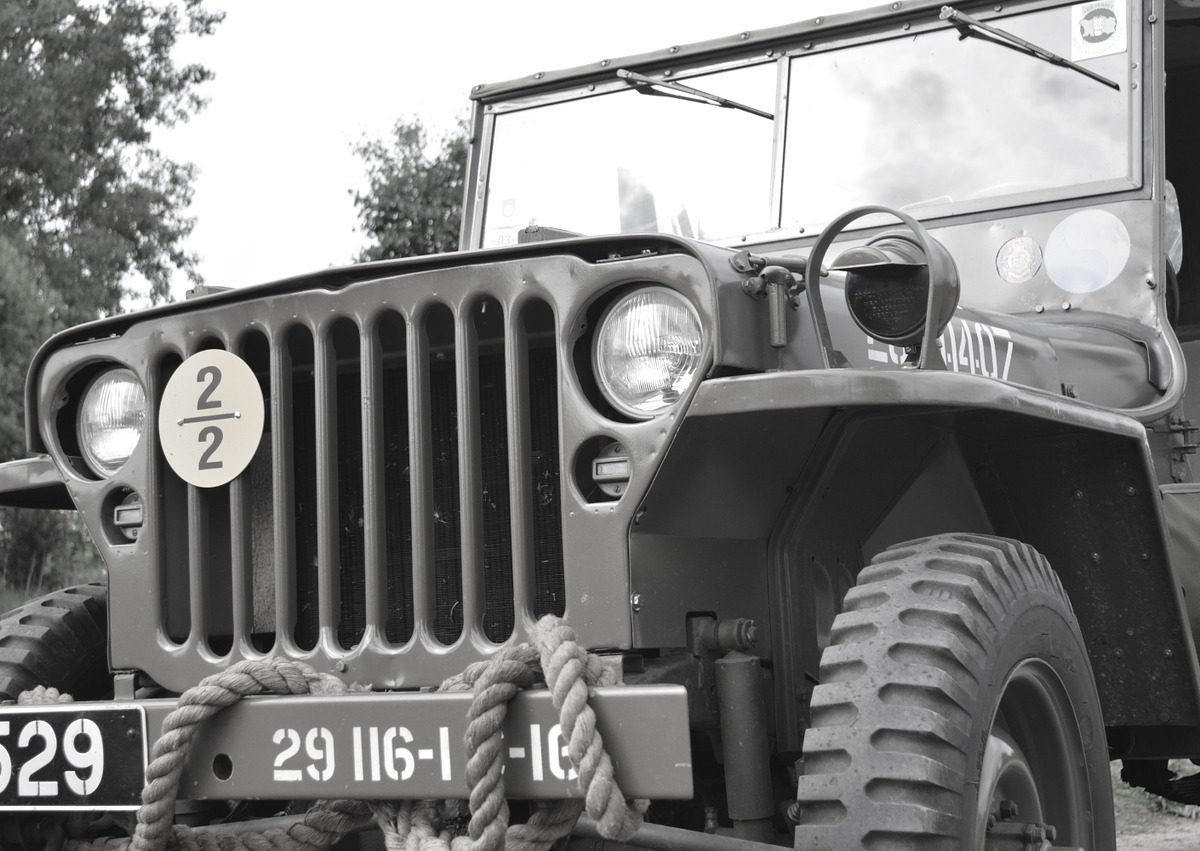
Production from the CJ2A overlapped the introduction of the new CJ3A. The most visible difference between the two is the windshield, which had a one-piece glass and an air vent located beneath the glass. Dual windshield wipers were mounted at the bottom of the windshield frame. In 1951, Willys offered a chassis only version and a Farm Jeep with standard PTO (power-take-off). Over 300,000 CJ3As were produced. Base price in 1949 was $1270.

Despite the CJ-3A's already universal capabilities, Willys marketed a new "low-priced 'Jeep' tractor with the famous, 4-cylinder 'Jeep' engine, offers advantages found in no other tractor. With 4-wheel drive, it has the extra tractive power needed on loose or slippery soil. The 'Jeep' Tractor comes equipped with hydraulic lift and is highly efficient with either 3-point hitch implements or standard pull implements. In low range it pulls steadily at tractor speeds and has high-range speeds that save time getting to fields and make it useful for many farm jobs."
The 134 cubic inch 4 cylinder L head "Go Devil" engine produced 60 horsepower @ 4000 rpm and 105 ft. lb. torque @ 2000 rpm.

T90 3 speed manual transmissions and Dana Model 18 transfer cases were used. Front axle was Dana Model 25 and rear axle was upgraded to Dana Model 44.
Useful measurements:
80" wheelbase
130" overall length and 69" wide
27" windshield height
6" hood height
Production Information
YEAR BODY MODEL START END UNITS
1949 CJ-3A 10001 37749 27749
1950 CJ-3A 37750 63784 26034
1951 CJ-3A 451 GB1 10001 54158 44158
1952 CJ-3A 452 GB1 10001 38652 29652
CJ-3A STCH 452 GA1 10001 10013 13
1953 CJ-3A 453 GB1 10001 20617 10617
Serial numbers are located on the left front of the frame and on the back of the bumper. The engine number was located at the front of the engine block on the water pump boss.
Changes in the CJ-3A
Modifications to the body tub, as mentioned above were for more head room and room for more “girth” behind the wheel.
At a glance the major difference is the windshield frame, which was simplified with the wipers at the bottom, and made taller for more headroom. The CJ-2A windshield frame is constructed with a round tubing framework. The upper corners of the frame are square. The CJ-3A windshield frame is constructed from rectangular tubing and the upper corners are rounded. The CJ-3A also has a vent in the panel below the glass.
The CJ-3A advertised increased space for the driver compared to the 2A. This was accomplished by shortening the rear wheelwell and moving the driver’s seat rearward. The length of the 3A wheelwell from the top front edge to the rear of the body is 32". The length of the 2A wheelwell is 34". This entailed moving the wheel wells back and a consequential shortening of the rear deck.
Other modifications came along with production. The first 3A's came out with the 42-2 rear axle, a continuation of the development of the late 2A. In the spring of 1951 the rear axle was changed to the 44-2, which has a history of its own.
And the suspension was beefed up a bit, perhaps in answer to calls from the agricultural community who by now had a wide array of implements to choose from, designed to be mounted on and operated by a Jeep CJ.
The 3A continued in production into early 1953, overlapping the introduction of the 3B by several months. Total production was approximately 130,000, less than either the 2A or 3B, which largely accounts for the 3A's relative scarcity.
The M38 and CJ-V35/U
The M38 is the military version of the CJ-3A. Another close relative is the rarer Navy specified, CJ-V35/U.

Willy's again produced a new Jeep for the US military in 1950 for the Korean War. Initially referred to as MC, it later became know as M38. The M38 very closely resembled the CJ3A. It had a one-piece windshield glass and the wipers were mounted on the bottom of the windshield frame. Headlamps had protective guards and driving lights were blackout military type. The frame and suspension were stronger than the CJ3A and it used a 24-volt electrical system. Other military requirements further separated it from the CJ3A. They saw combat in Korea, but production was low at 61,423 units from 1950-52. An export version was built from 1953 to 1955 for foreign military forces.
The 134 cubic inch 4 cylinder L head "Go Devil" engine produced 60 horsepower @ 4000 rpm and 105 ft. lb. torque @ 2000 rpm. T90 3 speed manual transmissions and Dana Model 18 transfer cases were used. Front axle was Dana Model 25 and rear axle was upgraded to Dana Model 44.
Useful measurements:
80" wheelbase
130" overall length and 69" wide
27" windshield height
6" hood height
The CJ-V35/U was developed for the US Navy and is one of the rarest of Jeeps. On February 1, 1950 the contract was approved for 1,000 units “especially adapted for general reconnaissance or command communications” and “constructed for short period underwater operation such as encountered in landing and fording operations." The Navy wanted a waterproofed radio jeep. This contract was the first Jeep contract after World War II and the only Jeep purchased by the U.S. Government between World War II and the Korean Conflict. The Navy designation for this vehicle was: Truck ¼ - ton 4X4 V-35/U (the /U stands for underwater) ‘for general radio use.

Production began in March 1950 and the total of 1,000 units was completed by June 1950. Engine serial numbers have the prefix letter 'V' and start with number 10001 and chassis numbers have the prefix CJ-V35 and, also started with number 10001 ending with number 11000. The entire contract was intended for use by the United States Marine Corps.
From the outside the CJ-V35/U looked like a 3A, with the following exceptions:
Wheels are MB-style, combat rims.
Headlamps have deep protective bezels.
Tow hooks are provided on the front frame extensions.
Lifting rings are provided front and rear.
A cut-out is provided in the right-hand hood side for the intake snorkel.
Radio antenna mounting bracket is provided on the left rear corner.
Ignition switch is the MB-style combat toggle.
Lighting switch is similar to the MB-style rotary switch.
A late MB-style stamped pintle hook is provided.
An MB-style trailer socket is provided.
An auxiliary generator is provided between the two front seats.
There are identifying data plates on the dash and firewall.
Under the hood, however, it looks more like an M38, with the fully waterproofed ignition and charging system and the pressurization system for the transmission, transfer case, and fuel tank. The main difference is that the M38 has two, 12-volt batteries, while the V-35 has only one 6-volt battery. The distributor is a waterproofed Bendix-Scintilla type, which is quite different from the later M-series unit.
There is that no black-out lighting. The light switch, similar in appearance to the MB rotary style, has only three positions: ‘park’, ‘off’, and ‘drive.’ There are two seven-inch headlamps, two civilian style parking lamps, and only one combination stop and tail lamp, mounted on the left hand rear.
All came equipped with a 12-volt auxiliary generator, driven by a V-belt from a power take-off mounted on the rear of the transfer case. The auxiliary generator was mounted in a metal 'dog-house' between the two front seats. Two battery boxes were mounted immediately behind each front seat and held two 6-volt batteries, providing power for the radios. A waterproofed radio cabinet was mounted across the rear of the vehicle.
The Dispatcher Jeeps
DJ-3A (1955-1965)
I am including this discussion of the DJ-3A because of the obvious relationship to the CJ-3A, even though it was not produced until 1955, two years after the last 3A was produced.
The two-wheel drive Willys DJ-3A "Dispatcher" has a lot in common with the CJ-3A. It was an inexpensive Jeep whose design was largely an efficient, practical recycling of existing tooling and technology. And it is largely unknown today in North America; people are always trying to figure out what this Jeep is.
The DJ made its debut in 1955, advertised both as a convertible recreational vehicle and as America's Lowest Priced Delivery Vehicle. Designed around the body style and L-134 engine of the CJ-3A, the Dispatcher was the first Jeep since the early CJ-2A to have a steering column-mounted gearshift. Another distinguishing characteristic was the 4-bolt wheels, hidden by hubcaps.
In 1959 it was offered in the “Surrey Gala” version, but it had more success as a no-nonsense working vehicle.


The 1960 Dispatcher in this photo was used by Continental Airlines for towing luggage wagons at the old Denver airport. It was in service as late as 1990 based on the vehicle permit on the windshield, but still has the original L-head engine.

Airlines also used Dispatchers as mobile airport loading ramps, with the right rear quarter cut diagonally to carry the sloping ramp.